Cubism Define Picasso Cubism Marked Beginning of Modern Art
The fine art motility known as cubism arose out of the demand to define and stand for the then new modernistic reality. This new reality was complex and cryptic, shaped by new inventions, philosophical speculation and cultural diverseness. The new technology and scientific discoveries were radically irresolute the pace of life and the style guild perceived the nature of things. Whereas in the by, life had been static, science and technology were now forcing modern man to feel time, movement and infinite more dynamically. All of a sudden he was thrust in a world of expanding vision and horizons, of accelerated tempo and mobility and of fluctuating perspectives. Furthermore, the ambiguity and sense of uncertainty generated by this new rush of stimuli was interpreted by the theory of relativity that evolved through F. H. Bradley, Whitehead, Einstein, and the new mathematics. What these philosophical theoreticians suggested was that nosotros live in a earth of shifting perspectives, where the advent of objects is in a constant flux depending on the point of view from which it is seen. Finally, the experience of reality was besides being contradistinct by the cultural interactions taking identify between the Due east and West, the primitive and the industrialized. In other words, each culture brought along with it a new, idiosyncratic way of looking at things, and the interchange occurring betwixt cultures obscured the perception of truth. Relativity became everything.
The trouble facing the modern creative person became how to formally depict this new dynamic vision of life. For the painter, specifically, the dilemma became representing the flux of time, motion and space in a medium that lent itself to the mere capture of the fleeting moment. Cubism was born equally a response to this predicament, and it is no accident that the movement was a Parisian phenomenon, considering the metropolis'south artistic legacy and its magnetic ability to concenter the nigh gifted young artists and writers from all over the world. Paris offered them great art museums, a tradition of moral and artistic liberty, and an creative bohemia where they could live cheaply on the margin of bourgeois lodge.
Perhaps nosotros tin can say that Pablo Picasso'due south Les Demoiselles d'Avignon ushered in a revolutionary fashion of depicting reality. This landmark painting had broken all of the traditional rules that artists at the fourth dimension followed, specially the one that defined art as imitation rather than cosmos. Picasso had decided to plough his back on a stock-still point of view and harmonious proportion, concepts that had been religiously practiced since the Renaissance. Instead, he replaced these with multiple perspectives and distortion. Furthermore, he incorporated into his painting references to primitive art, a do that ran counter to the ceremonious adulation of the whole continuum of Western art. For nearly people, Les Demoiselles was a desecration of everything that had been held as sacred. But fortunately, Picasso'due south rebelliousness cleared the air for what was to come: a liberty to create rather than imitate and to construct a new pictorial linguistic communication.
Cubism was born out of the interaction and collaboration that occurred between Picasso and Georges Braque right subsequently they met in 1907. When Braque saw Les Demoiselles for the first time, he went into a state of shock. Still, many months later on this initial encounter and much reflection, Braque reconsidered his initial reaction and responded with Large Nude (1908), in which he follows Picasso'southward atomic number 82 and combines several points of view in one image. Shortly later, an artistic partnership developed between the two artists that was to define the nature of painting for years to come up. At first, Picasso was concerned with the formal and technical freedoms that African art and masks had inspired while Braque experimented with the revolutionary innovations in Les Demoiselles. Picasso'due south Damsel (1907) captures the tribal stance as well as the formal distortion and coarse hatching and scoring of archaic fine art. Only Braque would take a sobering voice in this artistic relationship. His function was to neutralize Picasso'south artistic savagery by incorporating it into Paul Cezanne'south more conservative formal legacy of reducing reality to basic geometrical shapes that are clearly continued with one another. Out of this artistic reconciliation, Analytical Cubism, the first phase in the evolution of Cubism, was born.
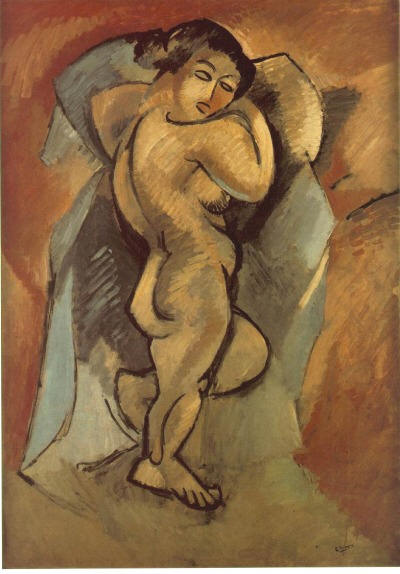
Large Nude (1908)
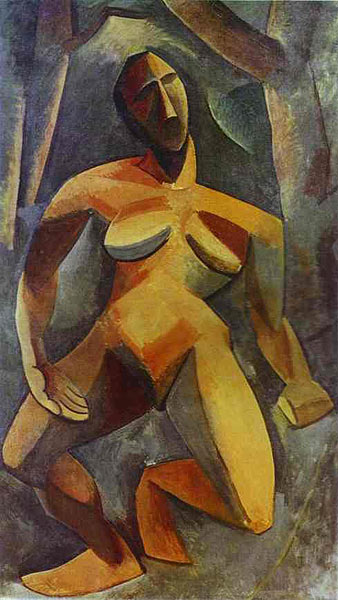
Dryad (1908)
In the offset of their artistic partnership, Picasso and Braque had become consumed with Cezanne�due south feeling for the �architecture� that underlies nature and with his statement that �everything in nature is based on the sphere, cone, and cylinder.� Cezanne�s piece of work likewise suggested to Picasso and Braque that art was neither an simulated nor an illusion of reality, but, in effect, a new kind of reality, created through the means of a new �language� of forms. For C�zanne, a pic is important in its own correct, and thus, it must remain true-blue to itself. Thus the aim of painting is not to pretend that the viewer is looking through a window, but to make the viewer enlightened of the picture surface itself as well equally the subject matter it depicts.
Picasso and Braque took both of these notions one step further. Whereas Cezanne believed that the written report of an object was the real solution to all of the painter'due south bug, Picasso and Braque had become totally absorbed by the problem of representing the complexity of reality in fine art. Because they lived in an historic period which was very distinct from Cezanne's, their perception of reality was unlike. They believed that our knowledge of things was composed of its multiple relations to each other and change their appearance according to the indicate of view from which we see them. Furthermore, they perceived the cubist object as the point at which thought about the object intersects our sense impressions and feelings almost it.
Analytical Cubism: Mapping Reality
As its proper noun implies, the paintings associated with the Analytical Cubism phase show testify of a methodology through which Picasso and Braque used to "interruption down" the surface of the objects being represented into basic, geometrical shapes. Picasso's Adult female with a Fan (1908) is a volumetric study of a adult female whose features are simplified into spheres and triangles and suggests a sculptor at work, every bit indeed Picasso was. It is C�zanne taken to the extreme. Another painting that shows the difference in pictorial technique between the cubists and C�zanne is Houses at l'Estaque (1908). Here, Braque borrows the aforementioned colors and geometric shapes that C�zanne uses in his Mont Sainte-Victoire paintings. But here the similarity ends, for a panoramic, fixed view of the mural is not enough for Braque. What Braque does is subordinate colour in order to attain a geometric structure of overlapping, shifting, tilted cubes that seem to project out of and into the picture airplane, as though we were watching a 3-D movie. The effect that is created is non that of a unmarried-point linear perspective, rather, that of a scene changing as it is observed from various positions. In other words, Braque was trying to record the procedure of seeing, and, in society to do so, he has constructed a composite of several dissimilar simultaneous views of the objects to be viewed in ane synthetic moment. By doing this, Braque transformed the sail from existence the static tape of a fleeting moment to a more dynamic vision akin to moving pictures. The canvas, and so, became like a screen onto which images are projected.
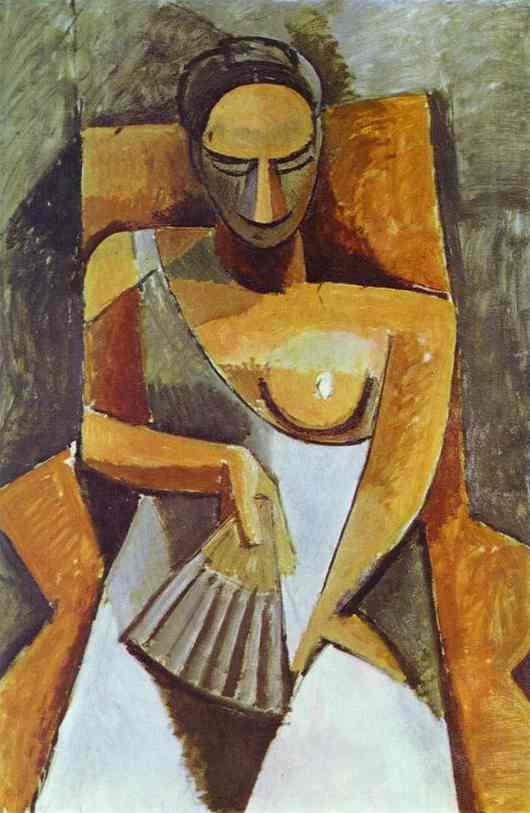
Adult female with a Fan (1908)
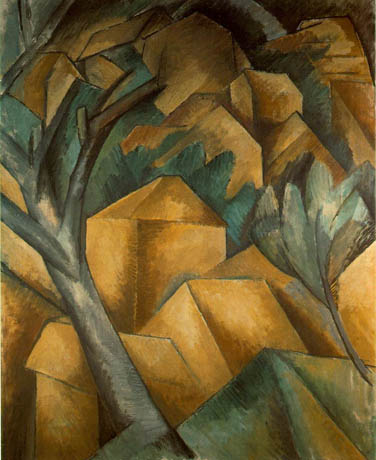
Houses at l'Estaque (1908)
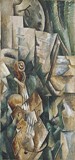
Violin and Palette (1909).
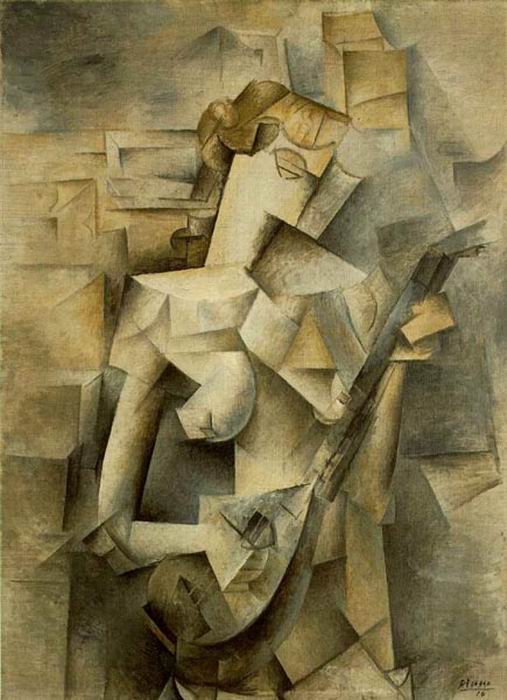
Girl with Mandolin (1910)
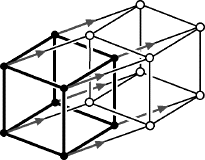
The Fourth dimension
These new ideas near a reality that is in a constant state of constant flux injected the chemical element of doubt in Picasso and Braque�due south ongoing argue about the nature of the artistic process. How does 1, they asked themselves, capture the ethereal, shifting quality of reality, where object and surround become inseparable? How does 1 reconcile the intellectual and intuitive faculties when they appear and so antithetical? What so is the relationship between the coherent artifice of traditional �realistic� art and the incoherent processes by which we experience our environment, between Renaissance perspective and multiple points of view as a result of the acceleration of the pace of modern life? Where does the spectator stand? and the object? The result of these rhetorical questions, the paintings of 1910-11 probe further and farther into the nature of realistic illusions and gradually refine the balance in which the spectator was poised, between the internal world of the painting�due south structure and the external earth of its references to reality. Now Picasso and Braque�s business concern shifted to creating a new artistic language that would express the multiplicity and complexity of these relationships and, at the aforementioned time, suggest stability. What they jointly adult was a new kind of painting, one that emphasized pictorial configuration rather than motif, thus moving in the management of brainchild. To achieve this new pictorial structure, Picasso and Braque replaced the traditional perspective by a shallow space in which in that location is little distance betwixt effigy, foreground and background. Consequently, the eye is not led back into an imaginary distance but is held on the painting�south surface, and yet, at the same time, is invited to experience iii-dimensionality in a new manner. The artist is now free to pause apart the object into small facets or pieces and distribute them well-nigh the canvas as the composition requires. The painter can show the back, front end or side of an object simultaneously. Art historians refer to this stage of cubism as �facet cubism,� �high analytic cubism� and
Past the end of 1910, Picasso farther explores this new phase of analytical cubism in Portrait of Ambrose Vollard although he is nevertheless committed to the rendering of the particulars of his subject area matter. Picasso�southward great power as a caricaturist is demonstrated in this painting, in which a powerful floating baldheaded caput, the defining characteristic, emerges every bit the product of several combined viewpoints from the muted monochromes of an angular maze. In this painting the effigy of Picasso'southward famous art dealer has dissolved into the cubist filigree, with just his facial structure, protruding jawbones, pug nose, the color and texture of ruddy flesh and low-cal-brown hair, beard and mustache. Vollard is seated facing united states of america; behind him is a table, on which are a bottle, on his right, and a book, perhaps a ledger, on his left. Picasso has even included the handkerchief in Vollard�s pocket. The famous dealer is portrayed every bit existence very cerebral as he gazes downward at a rectangular shape, which judging from his expression of shrewd critical discernment may be a work of art. The whole surface of the painting is a serial of modest, intersecting planes, any one of which can be interpreted as beingness both backside and in front end of other, adjoining planes.
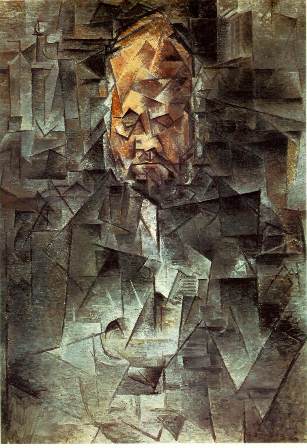
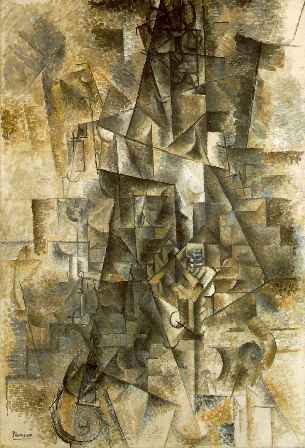
Portrait of Ambrose Vollard (1910) The Accordionist (1911)
This reductive, fragmenting process is taken even further in The Accordionist (1911), where the figure has been so fragmented that it is no longer apparent what is beingness represented, and so the championship purveys the clue equally to the nature of its subject field affair. The triangular scaffolding grid provides the structure on which to suspend the almost unrecognizable fragments of this musician. The only recognizable vestiges of the accordionist�due south instrument are the keys and bellows shown fragmented from multiple viewpoints, located center left of the painting. More than than an analysis, this painting is an assembling of parts. The upshot of Braque and Picasso's experimentation was true liberation from the Renaissance' concept of conceiving the world from the static indicate of view of geometrical perspective and of portraying painting equally an deed of imitation. This break with the past entitled artists to all kinds of new possibilities.
Picasso and Braque's experimentation with the very concept of constructing a work of art lead them into the final phase of cubism--synthetic cubism. As its proper noun implies, synthetic cubism worked on the premise of assembling out of separate parts new forms. What they were trying to recreate in this phase of cubism is how modern urban street life appears to the onlooker. Whereas in the analytical phase Picasso and Braque were deconstructing and and so reassembling bits and pieces to suggest objects as seen from multiple angles, in this latter stage they were interested in superimposing fragments i on top of another to simulate walls plastered with posters as well equally stacked newspaper displays at kiosks. Furthermore, they no longer concerned themselves with the representation of infinite because now the accent was on digesting multiple layers of information and shapes. The cease results were compositions that were simpler, brighter, and bolder accomplished through the following techniques:
- bringing together familiar scraps and unfamiliar forms in social club to give shape to a particular sense of urban life
- exploring the private experiences associated with public spaces and urban recreation
- using the language of publicity and commerce in an ambiguous manner to suggest a multiplicity of contradictory meanings, especially through puns
- capturing the new sense of simultaneity of diverse experiences-the fusion of objects, people, machines, noises, light, smells, etc.
How was it that Picasso and Braque decided to change the way that they were depicting reality? While Picasso preferred the more than traditional subject matter of nudes and portraits, Braque oscillated to even so lifes and landscapes. Nevertheless, it is around this time that Picasso and Braque began to paint like twins, their work becoming undistinguishable from one another. Colour, texture, and linear construction are about the same. But Braque, always the pragmatist, nudged Picasso by reminding him that their work was becoming and so abstract that subject matter was no longer recognizable. In society to bring painting back to reality, Braque introduced a new element to their piece of work--visually realistic objects taken from popular culture. Even earlier this point in the evolution of cubism, Picasso had already pasted a pocket-sized piece of paper on the center of a drawing to make what was the first papier coll� or collage in 1908. As early as 1910, both artists had been incorporating words, letters and numbers into their paintings, and Braque, in particular, had used trompe-l'oeil wood-grain furnishings. This technique came naturally to Braque since he had been a business firm painter earlier condign an creative person.
By re-instating recognizable elements from everyday life into their paintings, Picasso and Braque were asking a very important rhetorical question about the very nature of art: What is more real, art or reality? Through their further exploration of this question, Picasso and Braque seemed to be implying that they are both just as real for they can co-exist on the same plane, the aforementioned canvas. Of a sudden both of these artists introduced bits of observed nature onto the sail, likewise every bit products of modern industry: sheet music, newspaper, playing cards and restaurant menus. As in music, Picasso and Braque were employing scraps of reality equally counterpoints to the abstract structures created through paint. Again, Picasso and Braque had revolutionized the world of art. This new phase in the evolution of cubism became known as collage.
Picasso's commencement collage is Still Life with Chair Caning (1911-12), on which he embeds a piece of oilcloth that simulates chair caning. What Picasso seems to be suggesting here is that there are many different levels of reality, for the oilcloth itself is a manufactured representation of some other craft--caning. Looking closely at this collage, information technology appears that the painted parts of the work draw a glass in the heart, behind which lies a copy of the newspaper Le Journal (hence the messages JOU) and a white dirt pipe. To the correct are 2 lemon slices and a knife, and below them what might be an oyster crush. The shadows or refractions from the glass lie beyond the oilcloth, and towards the bottom edge of the canvas a brown strip seems to represent the front edge of the table. Finally, the oval shape of the painting is �framed� past a piece of real rope. What Picasso has managed to do here besides reminding us that manufactured materials, words, and even art are all similar in that they are means of representing reality and that, furthermore, by including them all together he has challenged the traditional demand that artists should strive for artistic unity. Thus their juxtaposition in the aforementioned picture makes the point about the nature of linguistic communication but also blurs the distinction betwixt them. Even the oval shape of the sheet signifies something else: the seat of a chair or the surface of the caf� table on which the objects sit. Since the French discussion for an easel picture is tableau, Picasso delights in the joke that his picture is a vertical tableau which is as well a horizontal tabular array.
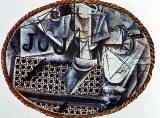
Still Life with Chair Caning (1912)
Just as Picasso and Braque�due south art had explored the philosophical ideas of Bradley, Whitehead, and Bergson, they at present began to flirt with the inclusion of verbal and musical linguistic communication in their works. At the turn of the century, linguists in Europe and the U.s.a. had begun to wonder what linguistic communication actually was and how to depict it, leading to a new appreciation of the importance of structures and codes to linguistic meaning and the arbitrary adventitious nature of the fashion language describes reality. These ideas became the basis of the study of signs known equally semiotics. Although Picasso and Braque couldn�t have been more removed from these bookish studies, their work of this menses, nevertheless, is a attestation to their questioning the relationship between art, language and representation.
Although it was Braque who invented the thought of collage, information technology was Picasso who beginning executed it. Still, Braque invented and executed the start papier coll�, a kind of collage consisting of papers that are glued onto the canvas. Braque�s inclusion of paper seems to be analogous to the addition of the oilcloth. But Braque�s utilise of wallpaper does this and more. What Braque has discovered here is that there are ready-made materials that simulate �woodness,� that do not take to be fatigued or painted and that can exist cutting up and manipulated, that are e'er the same no matter what the �light� in the picture, and that tin announced independently of the shape of the object of which they are meant to be a part. Braque has added the element of materialism into painting. And then instead of painting something onto the canvas, he just glued information technology on--whether it be newspaper scraps, wallpaper, paper printed to resemble something else, advertisements, etc. Furthermore, Braque used all kinds of decorative painting techniques learned from his days as a house painter. He incorporated combing, imitation graining, and adding sawdust and sand for texture. Braque too added shadows with graphite and charcoal thereby mixing drawing and painting techniques. A case in point is Braque's Woman with a Guitar (1913) in which the creative person assembles a woman playing a guitar from dissimilar layers of shapes, colors, and gear up-made materials stacked to create her essence.
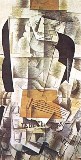
Woman with a Guitar (1913)
So why were Picasso and Braque incorporating mundane materials such every bit oil cloth and wallpaper? One suggestion comes from a purported conversation between Picasso and his mistress Francois Gilot that took identify many years later:
We tried to get rid of trompe l�oeil to find a trompe 50�esprit (deception of the mind/spirit). We didn�t whatsoever longer want to fool the eye; we wanted to fool the mind. The sail of paper was never used in lodge to make a paper. It was used to become a bottle or something like that. It was never used literally only always every bit an element displaced from its habitual definition at the point of departure and its new definition at the indicate of arrival. If a piece of newspaper can get a bottle, that gives u.s. something to think about in connection with both newspapers and bottles, too. The displaced object has its strangeness. And this strangeness was what nosotros wanted to brand people call up virtually because we were quite aware that our globe was condign very foreign and not exactly reassuring.
Collage and papier coll� gave Picasso and Braque the opportunity to pursue the estrangement as well as the diverseness of modern life. Furthermore, introducing real objects into their paintings allowed them to remove the distinctions between what is real and what is created past the creative person, between art and mass-produced objects, and betwixt painting, cartoon, and commercial art. As Picasso himself said, �Fine art is a lie that helps u.s. understand the truth.�
While Picasso and Braque were experimenting, a coterie of artists were scrutinizing what these two leaders were doing, came nether their influence, exhibited together and ultimately were labeled as existence cubists also. Next to Picasso and Braque, Juan Gris was maybe the most famous of this group. As a matter of fact, his work, which was from the get-go synthetic in nature, probably inspiring Picasso and Braque to bring dorsum light and colour into their canvases. His manner tin can all-time be described as having intensely colored geometric planes which combine with familiar collage components to create a tightly interlocked pictorial harmony.
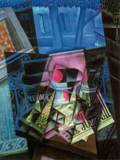
Nonetheless Life with Open up Window (1915)
Another important cubist was Fernand Leger, whose contribution to the art move was the celebration of the new machine age. Leger created his images of machine forms and robots from cylinders and cones, the basic building blocks of his work. The ultimate upshot of his work is a harmonious mechanical world where human happily participates.
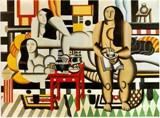
3 Women (1921)
Robert Delaunay was a cubist who steered away from the even so life and the figure, embracing the architectural prototype of the Eiffel Tower and the plane as the images of modernity. In his paintings, Delaunay was interested in capturing the whole dynamics of the new cult of the car. In his Eiffel Tower paintings, Delaunay portrayed the belfry as it loomed over the city during structure, arising out of it similar the new phoenix. In Homage to Bleriot, the artist celebrates the new dynamism of the new industrial age past painting vibrating discs of color that simulate plane propellers in motion.
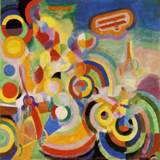
Homage to Bleriot (1913)
Source: https://www.mdc.edu/wolfson/academic/Artsletters/art_philosophy/humanities/cubism/cubism%20front2.htm
0 Response to "Cubism Define Picasso Cubism Marked Beginning of Modern Art"
Post a Comment