The Development of the Ballet Daction Showed That Ballet Was an Art of Considerable Flexibility

Classical ballet is any of the traditional, formal styles of ballet that exclusively employ classical ballet technique. It is known for its aesthetics and rigorous technique (such as pointe work, turnout of the legs, and high extensions), its flowing, precise movements, and its ethereal qualities.
There are stylistic variations related to an area or origin, which are denoted by classifications such as Russian ballet, French ballet, British ballet and Italian ballet. For example, Russian ballet features high extensions and dynamic turns, whereas Italian ballet tends to be more grounded, with a focus on fast, intricate footwork. Many of the stylistic variations are associated with specific training methods that have been named after their originators. Despite these variations, the performance and vocabulary of classical ballet are largely consistent throughout the earth.
History [edit]
Ballet originated in the Italian Renaissance courts and was brought to French republic past Catherine de' Medici in the 16th Century.[1] During ballet's infancy, courtroom ballets were performed by aristocratic amateurs rather than professional person dancers.[1] Almost of ballet'due south early on movements evolved from social court dances and prominently featured stage patterns rather than formal ballet technique.
In the 17th century, as ballet's popularity in France increased, ballet began to gradually transform into a professional art. It was no longer performed by amateurs, simply instead ballet performances started to incorporate challenging acrobatic movements that could only be performed by highly skilled street entertainers.[one] In response, the earth'due south start ballet school, the Académie Royale de Danse, was established by Male monarch Louis XIV in 1661.[i] The Academie'southward purpose was to meliorate the quality of dance training in France, and to invent a technique or curriculum that could be used to transform ballet into a formal subject area. Before long after the Academie was formed, in 1672, King Louis XIV established a performing company called the Academie Royal de Musique de Dance (today known equally Paris Opera), and named Pierre Beauchamp the head dancing-chief.[one] While at the Academie Royal, Beauchamp revolutionized ballet technique by inventing the five positions (showtime, second, third, fourth and 5th) of ballet, which to this twenty-four hours remain the foundation of all formal classical ballet technique.[1]
Famous dancers in history [edit]
– Anna Pavlova: 12 February 1881 - 23 January 1931
– Matriarch Margot Fonteyn: 18 May 1919 – 21 February 1991
– Rudolf Nureyev: 17 March 1938 – half-dozen January 1993
Development [edit]

Marius Ivanovich Petipa, February 14, 1898
Before classical ballet adult, ballet was in a catamenia referred to every bit the Romantic era. Romantic ballet was known for its storytelling, and ofttimes held a softer aesthetic. Classical ballet came to exist when a ballet principal past the name of Marius Petipa (who is considered to be one of the greatest choreographers of all fourth dimension) took Romantic ballet and combined information technology with different aspects of Russian ballet technique (as Petipa was once a choreographer and ballet master at Mariinsky Ballet). Elements pulled from these things include the storytelling establish in Romantic ballet, and the athleticism of Russian technique. Therefore, a new era of ballet, which afterward became known as the classical era, began. [2] Even though he was responsible for bringing in the classical ballet era, Petipa was also responsible for choreographing well-known romantic ballets such as Giselle and The Sleeping Beauty (ballet).
During the classical era, Marius Petipa was largely responsible for creating choreographic structures that are still used in ballets today. For ane, Petipa was the first to utilise the grand pas de deux in his choreography. Additionally, he cemented the usage of the corps de ballet as a standard office of a ballet. Despite his ushering in of the classical era, these elements can be seen in his romantic ballets equally well.
Famous Classical Ballets [edit]
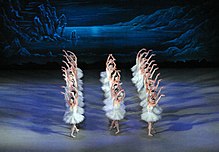
Dancers performing Swan Lake
– Coppélia: Choreographed by Arthur Saint-Léon
– Don Quixote (ballet): Choreographed by Marius Petipa
– Swan Lake: Choreographed by Marius Petipa and Lev Ivanov
– The Nutcracker: Choreographed by Marius Petipa and Lev Ivanov
Technique [edit]

Ballet technique is the foundational principles of body movement and form used in ballet.[3] A distinctive feature of ballet technique is turnout; which is the outward rotation of the legs and feet emanating from the hip. This was first introduced into ballet past King Louis XIV because he loved to bear witness off the shiny buckles on his shoes when he performed his own dances. At that place are 5 cardinal positions of the feet in ballet, all performed with turnout and named numerically as get-go through fifth positions. When performing jumps and leaps, classical ballet dancers strive to showroom ballon, the advent of briefly floating in the air. Pointe technique is the role of ballet technique that concerns pointe work, in which a ballet dancer supports all body weight on the tips of fully extended feet on particularly designed and handcrafted pointe shoes. In professional person companies, the shoes are fabricated to fit the dancers' feet perfectly.
Training [edit]
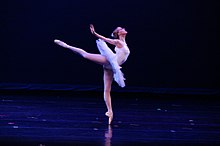
Ballerina dancing en pointe
Students typically learn ballet terminology and the pronunciation, pregnant, and precise body grade and movement associated with each term. Accent is placed on developing flexibility and strengthening the legs, feet, and trunk cadre (the heart, or abdominals) as a strong core is essential for turns and many other ballet movements. Dancers besides learn to employ their spot which teaches them to focus on something while turning so as not to become dizzy and lose their residual.
After learning basic ballet technique and developing sufficient force and flexibility, female dancers brainstorm to larn pointe technique and male person and female dancers begin to learn partnering and more advanced jumps and turns. Depending on the teacher and training organization, students may progress through various stages or levels of preparation as their skills advance.
Ballet form attire [edit]
Female person attire typically includes pink or flesh colored tights, a leotard, and sometimes a short wrap-skirt, or a skirted leotard. Males typically wearable black or nighttime tights, a form-fitting white, or black, shirt or leotard worn nether the tights, and a dance chugalug below the outer dancewear to provide support. In some cases, students may wear a unitard — a jumpsuit garment that combines tights and a leotard — to enhance the visibility of artistic lines.
All dancers article of clothing soft ballet shoes (sometimes called flats). Typically, female person dancers vesture pink or biscuit shoes and men wear blackness or white shoes. Leg warmers are sometimes worn during the early part of a grade to protect leg muscles until they get warm. Females are ordinarily required to restrain their hair in a bun or some other hair mode that exposes the neck that is non a ponytail. The customary attire and pilus style are intended to promote freedom of movement and to reveal body form and then that the teacher tin evaluate dancers' alignment and technique. After warming upward, advanced female students may wearable pointe shoes whereas avant-garde male students proceed to clothing soft shoes. Pointe shoes are worn after the student is deemed stiff enough in the ankles and tin execute the routine to a high standard, ordinarily around or after the age of 12, or after the dancers' anxiety take stopped developing, so every bit to protect the dancers' feet from injury common with premature wearing.
Methods [edit]
In that location are several standardized, widespread, classical ballet training systems, each designed to produce a unique aesthetic quality from its students. Some systems are named after their creators; these are typically chosen methods or schools. For example, two prevailing systems from Russia are the Vaganova method (created by Agrippina Vaganova) and the Legat Method (by Nikolai Legat). The Cecchetti method is named later Italian dancer Enrico Cecchetti. Another preparation organisation was developed by and named subsequently August Bournonville; this is taught primarily in Denmark. The Regal Academy of Dance (RAD) method was not created past an private, merely past a grouping of notable ballet professionals. Despite their associations with geographically named ballet styles, many of these training methods are used worldwide. For case, the RAD education method is used in more than 70 countries.
American-style ballet (Balanchine) is non taught by means of a standardized, widespread training system. Similarly, French ballet has no standard training system; each of the major French-style ballet schools, such every bit the Paris Opera Ballet School, Conservatoire National Supérieur de Musique et de Danse, and Académie de Danse Classique Princesse Grace (Monaco) employs a unique training arrangement.
| Ballet style | Training organisation | |
|---|---|---|
| Name | Creator | |
| Danish ballet | Bournonville method | Baronial Bournonville |
| Italian ballet | Cecchetti method | Enrico Cecchetti |
| Russian ballet | Vaganova method | Agrippina Vaganova |
| Legat Method | Nikolai Legat | |
| English ballet | The Royal Ballet School | Various |
| French ballet | Ballet Opera De Paris School | |
| American ballet (Balanchine) | None | |
Stage reference points [edit]
Some classical ballet grooming systems utilise standardized layouts to define reference locations at the corners, and edges of stages, and dance studio rooms. In the latter example, there is no audition and a mirror typically spans the downstage wall of the room (e.g., points ane-2 of the Cecchetti layout).
Phase layouts used in ballet training systems
-
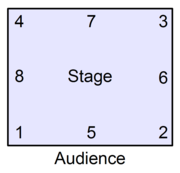
Cecchetti phase layout
-
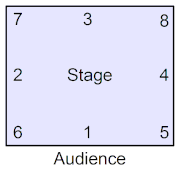
RAD stage layout
-

Vaganova stage layout
See also [edit]
- Contemporary ballet
- Neoclassical ballet
- Glossary of ballet
References [edit]
- ^ a b c d due east f Au, Susan (2002). Ballet and Modern Dance. Thames and Hudson. ISBN978-0-500-20352-one.
- ^ Victoria and Albert Museum (2013), Classical Ballet www.vam.air-conditioning.u.k./content/articles/c/classic-ballet/./
- ^ Grant, Gail (1982). Technical Manual and Dictionary of Classical Ballet. New York, US: Dover Publications. ISBN978-0-486-21843-4.
External links [edit]
- "Beginner's Guide to Ballet" (PDF). Archived from the original (PDF) on 2008-04-05. (iii.47 MiB)
Sources [edit]
- Anderson, Jack (1992). Ballet & Modernistic Dance: A Concise History (2d ed.). Princeton, NJ: Princeton Volume Company, Publishers. ISBN0-87127-172-nine.
- Banal, Alexander (1976). A History of Ballet and Dance in the Western World . New York: Praeger Publishers. ISBN0-275-53740-4.
- Chantrell, Glynnis, ed. (2002). The Oxford Essential Dictionary of Word Histories. New York: Berkley Books. ISBN0-425-19098-6.
- Kirstein, Lincoln; Stuart, Muriel (1952). The Classic Ballet. New York: Alfred A Knopf.
- Lee, Carol (2002). Ballet In Western Culture: A History of its Origins and Evolution. New York: Routledge. ISBN0-415-94256-X.
Source: https://en.wikipedia.org/wiki/Classical_ballet
0 Response to "The Development of the Ballet Daction Showed That Ballet Was an Art of Considerable Flexibility"
Post a Comment